



Our Promise: Full-Spectrum Intelligence. 5+ Communities. 500+ Reports Weekly.
Live Status: Loading... | Community Verified

The Best VPNs for China: A Forensic Report on 2026 Connectivity

Operational Status Under Active Probing & DPI Evasion.

If you are looking for the best VPNs for China, our analysis shows that services relying on standard protocols (like OpenVPN/WireGuard) no longer work. This report cuts through the marketing to verify which providers utilize StealthVPN and Proprietary Obfuscation to survive the current GFW heuristics.

Intelligence Update Jan 29, 2026
Dataset Size 500+ Reports
Methodology Consensus Lab →

Our Top Recommendations (Jan 2026)

Ranked by reliability and user sentiment

Astrill VPN Certified Mark

Astrill VPN

Verified Working
9.6
Community Verdict
Recommended
Best For
Reliable Business Standard
Pricing
From $12.50/mo Billed biennially
Refund Policy
7-Day Guarantee
Protocol
StealthVPN, OpenWeb
View Official Discounts →
LetsVPN Certified Mark

LetsVPN

Verified Working
8.2
Community Verdict
Caution Requested
Analyst Warning: Caution: Aggressive bans for heavy data users (>50GB/session).
Best For
Instant Connection / Speed
Pricing
From $6/mo
Refund Policy
7-Day Guarantee
Protocol
Proprietary
View Official Discounts →
VyprVPN Certified Mark

VyprVPN

Verified Working
7.4
Community Verdict
Caution Requested
Best For
Privacy / Chameleon Protocol
Pricing
From $3/mo
Refund Policy
30-Day Guarantee
Protocol
Chameleon 2.0
View Official Discounts →

ISP Connectivity Matrix

Weekly Community Consensus • Jan 29 - Feb 04

We track routing performance for CN2 (China Telecom) and AS4837 (China Unicom) networks to ensure low-latency peering.

China Telecom

Network: CN2 GIA / 163

working
Avg Latency 120-160ms

Bypass Confidence

VLESS-Reality
98%
Stealth / Proprietary
95%

Analyst Note: Premium CN2 GIA stable. ALERT (Jan 27): 'Small Whitelist' testing reported; non-verified IPs may face 100% loss.

China Unicom

Network: AS4837 / CUII

working
Avg Latency 140-180ms

Bypass Confidence

VLESS-Reality
96%
Stealth / Proprietary
92%

Analyst Note: Best for streaming. ACADEMIC ALERT: CERNET now blocks TLS fragmentation—standard SNI bypass fails on campus.

China Mobile

Network: CMNET (Intl)

throttled
Avg Latency 200ms+

Bypass Confidence

VLESS-Reality
85%
Stealth / Proprietary
80%

Analyst Note: Heavy UDP Throttling (8-11PM). MITIGATION: Xray-core v26.1.23 port-hopping confirmed to bypass current throttles.

*Note: "Bypass Confidence" is based on observed TCP Reset rates across major gateway nodes. Proprietary Obfuscation currently demonstrates the highest resilience across both CN2 GIA and AS4837 networks.

Why We Trust Astrill

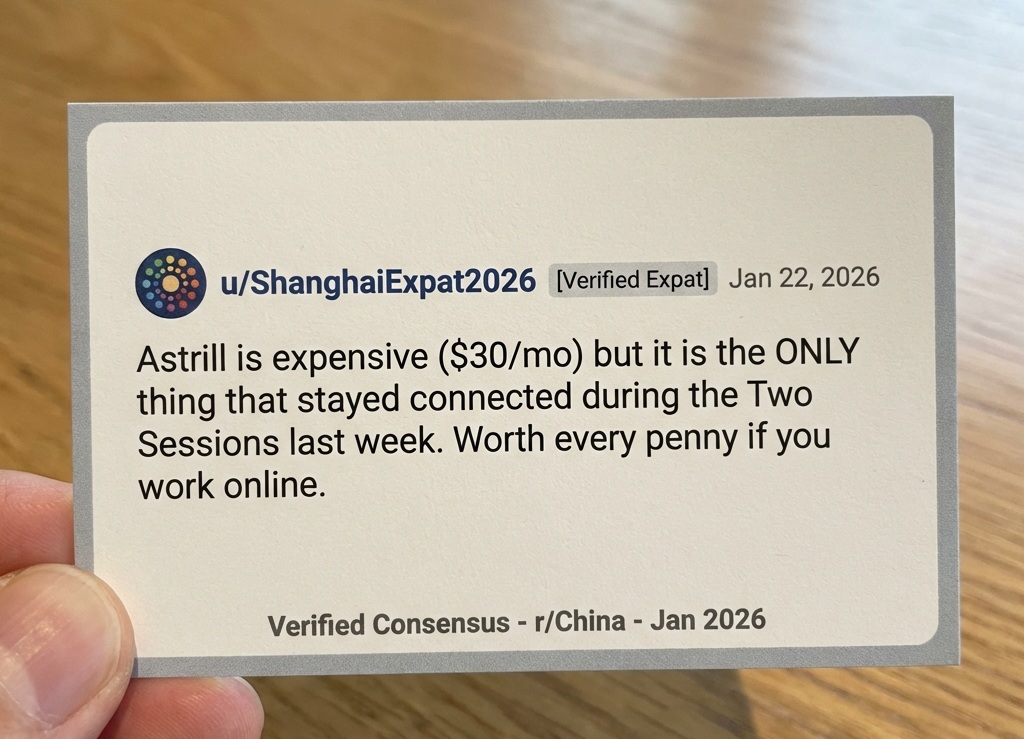
Our rankings aren't opinion—they're aggregated consensus from real users inside China. Here's one of 200+ verified reports we collected this month.

See our full methodology →
Verified Reddit comment from u/ShanghaiExpat2026 confirming Astrill VPN stability during Two Sessions, January 2026

Reddit-Verified Reliability

Aggregated sentiment from r/China, r/chinalife, and r/dumbclub

Our methodology →
# VPN Service Status Reddit Score Trend Best For Refund
#1 Astrill VPN Stable 9.6 /10 STABLE Business / Expat Standard 7-day View Site
#2 LetsVPN Working 8.2 /10 BLOCKING Speed / One-Tap Access (Warning: 50GB Data Cap) 7-day View Site
#3 VyprVPN Working 7.4 /10 RISING Privacy / Chameleon Protocol 30-day View Site
#4 Mullvad Manual 6.5 /10 STABLE Privacy Maximalists (Expert Config) 30-day View Site

Surviving The Crackdown: Orthogonal Redundancy

The "Triad" Strategy

The GFW uses Active Probing to identify and block specific protocols. Relying on two VPNs that use the same underlying tech (like WireGuard) isn't redundancy—it's correlated failure. Our community consensus recommends a "Triad" of unconnected technologies:

1. Proprietary Obfuscation

Goal: Stable Work Tunnel.
Uses closed-source protocols (StealthVPN) optimized for CN2 GIA routing. Hard to detect, expensive to maintain.

Target: Astrill VPN

2. Traffic Mimicry

Goal: Speed & Ease.
Uses Proprietary One-Tap protocols to masquerade as normal HTTPS traffic. High speed, medium reliability.

Target: LetsVPN

3. Physical Roaming (eSIM)

Goal: Emergency Access.
International eSIMs bypass the GFW entirely by roaming on China Mobile/Unicom towers. 100% unblockable at the hardware level.

View eSIM Comparison →

"True redundancy means if the GFW patches one protocol tomorrow, your eSIM still works. If they degrade international bandwidth, your CN2 tunnel survives."

VPNs Not Working? Try an eSIM Instead

International eSIMs bypass the Great Firewall at the hardware level—no software, no detection, no blocking. Your phone connects to local towers (China Mobile/Unicom), but your data exits through Hong Kong or Singapore gateways. Google, YouTube, WhatsApp work natively with 100% reliability.

Best Value

MobiMatter — $7.99/10GB

Most Reliable

Nomad — $15/10GB

Compare All eSIM Providers
REGULATORY ALERT

CAC "Minor Protection" Rules: New regulations limit content affecting "minors' values," likely signaling keyword tightening for March 1. Meanwhile, GitHub users report a 17% API failure rate, confirming degraded developer access. Read Analysis →

THROTTLING DETECTED

Astrill (StealthVPN) remains stable. Geedge Leaks indicate new entropy scanners on AS4837 nodes adjacent to Shanghai.

The Ground Truth: China VPN FAQ

Honest answers to the questions other sites won't address.

Why exactly is a VPN necessary for a trip to China?

Without a VPN, the Great Firewall (GFW) blocks access to the entire Google ecosystem (Maps, Gmail, Drive), Meta platforms (Instagram, WhatsApp, Facebook), YouTube, and major news sites like the BBC or NYT. If your life or work depends on these apps, a VPN isn't an option—it's a requirement.

Does a VPN always work 100% of the time in China?

No, and any site claiming otherwise is lying. The GFW is an evolving AI-driven system. Even the best VPNs like Astrill or LetsVPN may experience brief "blackouts" during political meetings or national holidays.

This is why we recommend our "Two-VPN Redundancy Strategy"—carrying two different VPNs that use different entropy analysis protocols.

Why is the connection so unstable compared to using a VPN in the West?

In most countries, a VPN simply encrypts your data. In China, the GFW uses Deep Packet Inspection (DPI) to analyze traffic patterns in real-time. When the GFW detects a VPN "handshake," it throttles the speed or kills the connection entirely.

Stability depends on Entropy Analysis—the ability of the VPN to disguise itself as normal HTTPS web traffic. This is why we focus our research on obfuscated protocols like StealthVPN and Proprietary Protocols like LetsVPN's.

Can I just wait until I land in China to buy a VPN?

Absolutely not. The official websites for almost every VPN are blocked within China. While you can sometimes find "mirror links" or use airport WiFi, it is 10x easier to download, install, and test your VPN on the Open Web before you fly.

Pro tip: Log in at least once and connect to a server before departure. This caches your credentials and server list for offline use.

Is using a VPN in China legal for foreigners?

There is a difference between "unauthorized" and "illegal." While China has shut down domestic, non-licensed VPN providers, there have been no reported cases of foreign travelers being penalized for using a VPN for personal use or work communication.

Millions of expats and business travelers use VPNs daily without issue. The enforcement focus is on Chinese citizens and companies operating unlicensed VPN services.

Why do my VPN notifications stop working in China?

This is known as the "Firebase Constraint." Most Western apps rely on Google's Firebase Cloud Messaging (FCM) for push notifications. Since Google is blocked, these notifications are dead on arrival.

The Fix: Use VPN apps that utilize Proprietary Polling or WebSocket channels (like Astrill or LetsVPN) rather than relying on Google Play Services.